
होमKabaddiCommonwealth Kabaddi Championship 2026: Does the Day-1 Points Table Tell the Truth or Create an Illusion?
Commonwealth Kabaddi Championship 2026: Does the Day-1 Points Table Tell the Truth or Create an Illusion?
कॉमनवेल्थ कबड्डी चैंपियनशिप 2026 का पहला दिन अहमदाबाद (भारत) में खेला गया, जिसमें पाँच पुरुष मुकाबले हुए। ग्रुप A में श्रीलंका (48–21, +27), भारत (46–26, +20) और युगांडा (45–29, +16) क्रमशः पहले, दूसरे और तीसरे स्थान पर हैं, जबकि नाइजीरिया बिना खेले चौथे स्थान पर है। ग्रुप B में स्कॉटलैंड (59–30, +29) शीर्ष पर और केन्या (48–28, +20) दूसरे स्थान पर है; बांग्लादेश और कनाडा बिना खेले तीसरे-चौथे स्थान पर हैं। रैंकिंग पहले जीत और फिर स्कोर डिफरेंस से तय होती है, इसलिए पहले दिन की तालिका का भविष्यसूचक महत्व बहुत कम है। स्कॉटलैंड के लवप्रीत ब्रार ने 23 रेड पॉइंट बनाए, जो पूरी रिपोर्ट का एकमात्र व्यक्तिगत आँकड़ा है। टूर्नामेंट में 13 टीमें (ग्रुप A में 7, ग्रुप B में 6) हैं; क्वालिफिकेशन नियम और नियम-प्रकार (स्टैंडर्ड या सर्कल स्टाइल) दोनों की आधिकारिक पुष्टि नहीं हुई है। 'कॉमनवेल्थ' लेबल के कारण ईरान जैसी शीर्ष टीमें संरचनात्मक रूप से बाहर हैं, जिससे प्रतियोगिता का स्तर एशियाई खेलों और कबड्डी विश्व कप से नीचे रहता है।
The opening day of the Commonwealth Kabaddi Championship 2026 in Ahmedabad looks ordinary on paper: five matches, thirteen men's teams, two groups and one points table. But read that small table carefully and it tells a much larger story — the real state of kabaddi's 'internationalisation' outside India, the quality of the tournament ecosystem that exists beyond the Pro Kabaddi League, and a format that structurally rewards lopsided victories.
Day 1 produced the following results. In Group A, Sri Lanka won 48–21, India beat England 46–26 and Uganda defeated Malaysia 45–29. In Group B, Scotland crushed Australia 59–30 and Kenya beat Singapore 48–28. Match totals were 69, 72, 74, 89 and 76 respectively. Group A has seven teams, Group B six — thirteen in all.
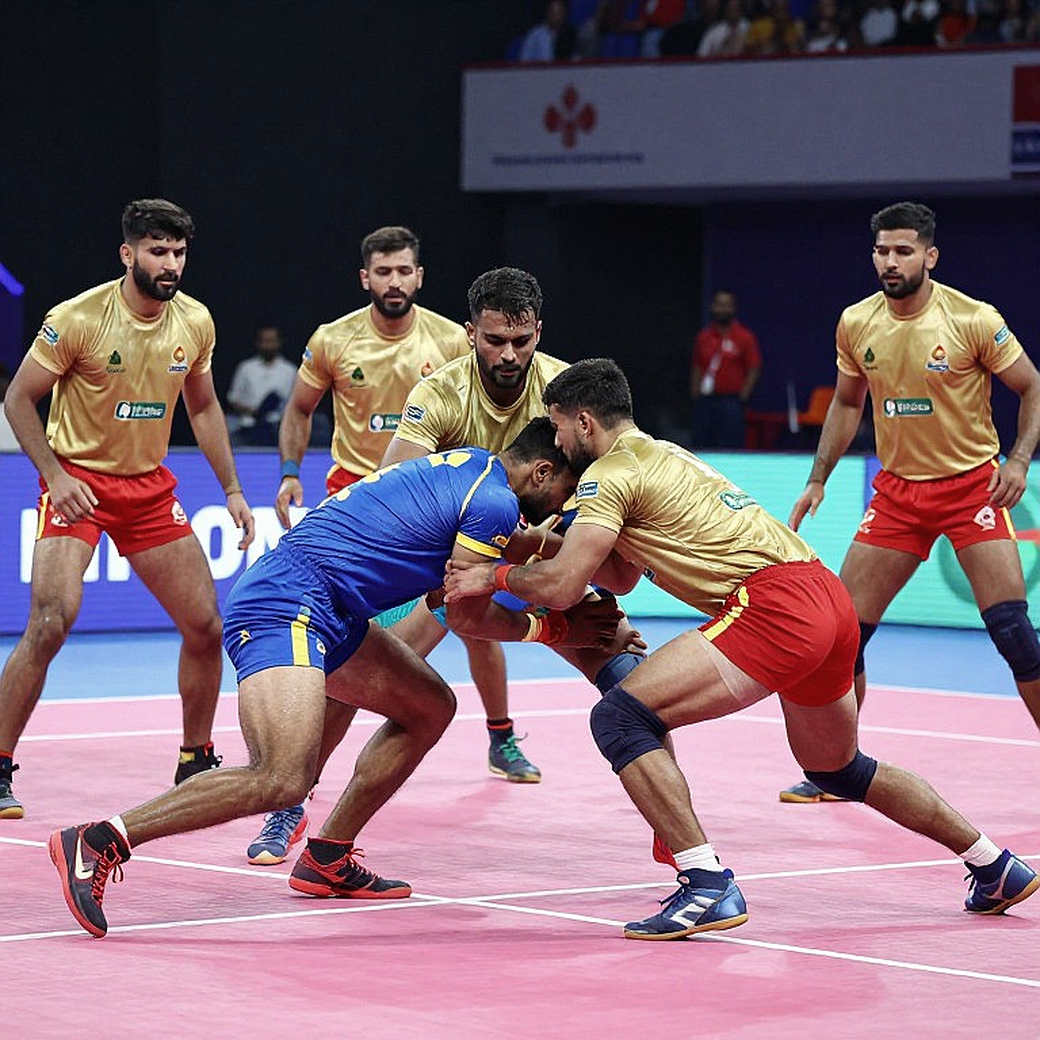
For readers new to the sport: kabaddi is best described as a competitive version of eagle-catches-chicks combined with wrestling-style contact. Two teams of seven alternate between raiding and defending on a 13m × 10m court. The raider enters the opponent's half with 30 seconds to touch one or more defenders and return safely; one touch equals one point. The defence collectively stops the raider — pulling him down, grabbing an ankle, blocking the path. The sport's most distinctive rule is the 'cant': the raider must chant continuously to prove he is not holding his breath. If the chant breaks, the raid is void and the raider is out. There is also the bonus line, the all-out (worth two extra points, after which the eliminated team returns), the do-or-die raid after two empty raids, the super raid (three or more points in one raid) and the super tackle (two points when completed with three or fewer defenders). Notably, the original report never states whether Standard Style or Circle Style rules apply — a serious information gap, since it changes the meaning of every technical statistic.
Back-calculating from the scores, the ranking logic can be fully reconstructed and is internally consistent. Group A: Sri Lanka +27, India +20, Uganda +16. Group B: Scotland +29, Kenya +20. This confirms the standard 'win first, then score difference' system, and it means the factual layer of the report is reliable and arithmetically verifiable.
But that same rule makes the table structurally misleading. Because ranking is by score difference, teams that have not played sit above teams that have lost. Nigeria is fourth in Group A without playing a match; Bangladesh and Canada are third and fourth in Group B without playing. This is not an error in the report but a mechanical artefact of the table. The practical implication: the Day-1 standings carry almost no predictive value, and in Group B, Bangladesh — yet to take the mat — is in all likelihood the true strongest side in the group. The author's repeated caveat that 'the table could change' is factually correct but analytically inadequate.
There is also a format asymmetry. Group A teams will play six matches, Group B teams five. Unequal match counts make cross-group score-difference comparisons less fair, and in the smaller group the incentive to run up the score is stronger, since a single blowout can decide top spot. That partly explains the extreme Scotland 59–30 Australia scoreline. The 89-point total in that match sits at the high end and points to weak defensive structure on both sides — though with no tackle statistics or raid-success percentages, this can only be a directional judgment.
On individuals, the report contains exactly one statistic: Scotland's Lovepreet Brar with 23 raid points. That is at least 39 per cent of the team's 59-point total, and since team totals also include tackle, bonus and all-out points, his share of the team's raid points specifically is almost certainly above 50 per cent. Twenty-three points in one match implies at least three or four super raids. It is an excellent individual performance — and a structural vulnerability, because neutralise one raider and Scotland's offence may stall.
That figure needs heavy discounting. Australia conceded 59, the worst defence of the day. One match against the weakest defence in the group is not evidence of a sustainable level; in PKL analytics, a single match sits well inside the noise band. Calling Brar a breakout star on this basis would be premature.
The name itself carries information. 'Lovepreet Brar' is a Punjabi name, and Scotland's kabaddi ecosystem is driven overwhelmingly by the British Punjabi diaspora, whose domestic culture is rooted in Circle Style — circular field, one-on-one offence and defence. Players raised in that tradition must adapt to Standard Style's 7v7 positional defence, bonus line and 30-second cant discipline. This adaptation gap is one of the most under-reported stories in diaspora kabaddi and plausibly explains the unusually high total in the Scotland–Australia match: weak structured defence on both sides.
The African results deserve more attention than they received. Kenya beat Singapore 48–28 and Uganda beat Malaysia 45–29 — two comfortable African wins over Asian opposition on the same day. In the standard narrative of kabaddi's internationalisation, African teams are usually cast as participants rather than competitors. Two wins is a small but genuine signal. With one match and no statistics, however, the correct conclusion is 'worth tracking', not 'power shift'.
India's 46–26 win over England is analytically unreadable as presented. A 20-point margin is solid but not dominant by India's standards — Sri Lanka's margin was larger. The decisive missing variable is squad composition: the report never says whether India fielded its senior national team or a development side. Without that, the scoreline supports no conclusion at all.
This points to the report's central gap. No rule variant, no qualification rules, no raid-success percentages, no tackle data, no lineups, no quotes, and 'Source: None' uniformly across all thirty-five information points. Everything suggests desk-based compilation from an official results sheet rather than on-site reporting, possibly semi-automated.
And the biggest analytical point: the 'Commonwealth' label is not a neutral descriptor but a structural filter. It excludes Iran, kabaddi's undisputed second power and the only nation to have broken India's Asian Games men's gold monopoly, because Iran is not a Commonwealth member. It also excludes South Korea, which runs a systematic kabaddi programme. It should also be stated plainly that 'Commonwealth' here is a membership label, not a Commonwealth Games Federation sanction — kabaddi is not on the Commonwealth Games programme.
The consequence is that this event sits below the Asian Games and the Kabaddi World Cup in tier — low-to-medium prestige. There are thirteen men's teams, but depth at the top is thin because the world number two is structurally absent. At the bottom there is breadth: Sri Lanka, Kenya, Bangladesh, Uganda, Scotland, England, Australia, Malaysia, Singapore, Tanzania, Canada, Nigeria.
India's dominance is overwhelming but unquantified here; a twenty-point win over England is unremarkable by historical standards. Group A is harder on paper, containing Sri Lanka, India and Uganda, while Group B's true strength, Bangladesh, has yet to play.
One further point matters for interpreting Day 1: in a short group stage ranked by score difference, the rational strategy for strong teams is to maximise margins against weak opponents rather than manage minutes. That structurally produces scorelines like 59–30 and 48–21 and reduces the event's competitive credibility.
Rule-variant risk also cannot be excluded. Several participating teams — Scotland, England, Canada, Australia — draw heavily on the Punjabi diaspora, whose domestic kabaddi culture is Circle Style, so a hybrid or inconsistent officiating standard is a genuine possibility.
So what does Day 1 teach us? First, the factual layer is reliable but the information layer is thin — essentially a standings screenshot turned into prose. Second, the table is structurally misleading rather than merely preliminary: three teams occupy mid-table purely because they have not played, and Bangladesh's third place almost certainly understates its strength by a wide margin. Third, the format itself encourages blowouts. Fourth, with no rule variant and no qualification rules, strategic assessment is impossible.
What to watch next: Bangladesh's opening match, which could redraw Group B entirely; confirmation of India's squad composition; whether Kenya and Uganda's wins were a one-day wonder or a sign of durable improvement; Scotland against a disciplined chain-tackle defence, which will reveal the true level of Brar's 23-point haul; and, above all, clarity from organisers on qualification rules and rule variant.
The broader comment is this: kabaddi's internationalisation is real, but its quality is uneven. The Pro Kabaddi League has created professional standards, statistics and broadcast value inside India. Tournaments outside it — like this Commonwealth-branded event — often sit far below that level, with limited data, unclear rules, uneven formats and desk-based reporting. That gap is the real story. The Day-1 points table cannot tell you who will win, but it can tell you that this event has a long way to go before its 'international' claim becomes meaningful.
संबंधित खिलाड़ी
लोकप्रिय/पसंदीदा पुस्तकें
Commonwealth Kabaddi Championship in Ahmedabad: What I'm Looking For Before the Scoreline2026-11-06
Another 'Vertical' in Ahmedabad: India's Rotation Policy Is the Real Story Against England2026-11-04
A Five-Crore Purse and a 17.4-Lakh Hammer: The Real Ledger of the Kabaddi Champions League2026-11-04
India vs England, Match 4: India Begins Campaign With a Rotated Squad in Ahmedabad2026-11-03
अनुशंसित
The Rs 1.65 Crore Receipt: Kabaddi's Auctions Still Buy Raiders, Not Teams2026-10-25
India vs Uganda, Match 9: Auditing the 'Commonwealth' Label, an Asian Games Claim and an Incomplete Scorebook2026-10-25
62 Matches, 13 Nations and One Empty Column: What the Commonwealth Kabaddi Championship's Fixture List Already Tells Us2026-10-29
Commonwealth Kabaddi Championship 2026: The Day-1 Points Table Is an Illusion, and That Is Its Biggest Truth2026-10-25
Kabaddi's Real Deficit: The Register Nobody Keeps2026-10-24
Major Gap in Kabaddi Analysis: Missing Source Data Makes Nine Key Areas Impossible to Evaluate2026-11-07
अनुशंसित
The Auction Crore Is Decided in the Do-or-Die Raid, Not in Total Raid Points2026-10-26
India vs England, Match 4: India Begins Campaign With a Rotated Squad in Ahmedabad2026-11-03
From Haryana's Mud Courts to a Rs 5 Crore Purse: Why the Kabaddi Champions League's Expansion Must Be Read Against the PKL Crisis, Not as Momentum2026-11-04
Pakistan's Name Is Off the List and Thirteen Nations Remain: The Real Reason Lives on the Mat2026-10-30
Kabaddi's Real Deficit: The Register Nobody Keeps2026-10-24
Commonwealth Kabaddi Championship 2026: Sri Lanka and Scotland Lead After Day 1, but the Real Story Lies in the Standings2026-11-07
62 Matches, 13 Nations and One Empty Column: What the Commonwealth Kabaddi Championship's Fixture List Already Tells Us2026-10-29
अनुशंसित
India vs Uganda, Match 9: Auditing the 'Commonwealth' Label, an Asian Games Claim and an Incomplete Scorebook2026-10-25
18-27: The Scoreline Indian Kabaddi Still Hasn't Read Properly2026-10-27
Nine Days, 62 Matches, Eight for a Finalist: The First Commonwealth Kabaddi Championship and the Workload Question Nobody Printed2026-11-03
Why the Dubki Halved: The Bonus Line, Do-or-Die and Kabaddi's Rewritten Risk Math2026-10-26
Commonwealth Kabaddi Championship in Ahmedabad: What I'm Looking For Before the Scoreline2026-11-06
Commonwealth Kabaddi Championship 2026, India vs England: Even a Big Margin Will Tell Us Nothing About This Squad2026-10-24
India vs England, Ahmedabad: The Real Contest Is a Rotation Audit, Not a Scoreline2026-10-24
The Seventh Column: Where Kabaddi's Transfer Market Actually Writes Its Price2026-11-07